
Whether you’re buying a home, renting a space, installing flooring, tiles, paint, or carpet, the first thing you need to know is the square footage (sq ft) of your space. This guide walks you through everything — from the basic formula to calculating square feet for a room, a full house, plot sizing, cost estimation, and common conversions.
What Is Square Feet?
Square feet is a unit used to measure area — the amount of flat surface something covers, like a room’s floor, a plot of land, or a wall. One square foot equals the area of a space that is 1 foot long and 1 foot wide.
The Basic Formula to Calculate Square Feet
For any rectangular or square space, the formula is simple:
Area (in square feet) = Length (ft) x Width (ft)
Just measure the length and width in feet and multiply them together.
Example:
If a room is 12 feet long and 10 feet wide:
12 x 10 = 120 square feet
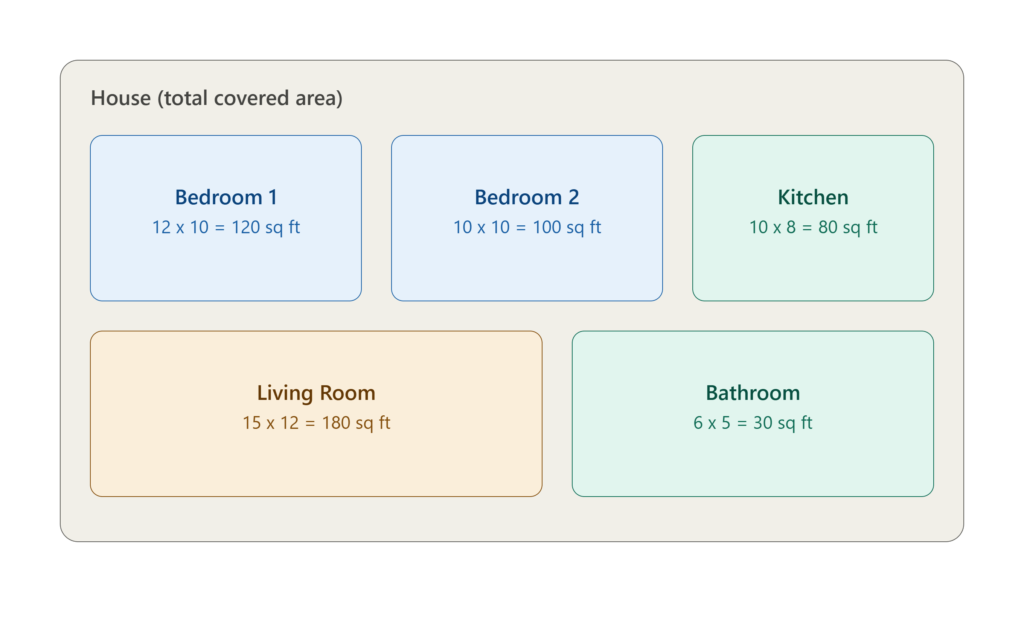
(This is the same example shown in the diagram above.)
How to Calculate Square Feet of a Room
Follow these steps:
- Get a measuring tape — a steel or laser measuring tape gives more accurate results.
- Measure the length — from one wall to the opposite wall, in feet.
- Measure the width — the wall perpendicular to the length, in feet.
- Multiply — Length x Width = Total square feet.
If the room isn’t a perfect rectangle (an L-shape or irregular layout), break it into smaller rectangles, calculate the area of each separately, then add them together.

Irregular Room Example:
For an L-shaped room, split it into two parts:
- Part A: 10 ft x 8 ft = 80 sq ft
- Part B: 6 ft x 4 ft = 24 sq ft
- Total = 80 + 24 = 104 square feet
How to Calculate Square Feet of a House
To find the total square footage of a house, calculate the area of every room, hallway, and covered space individually, then add them all up.
| Room | Length x Width | Area (sq ft) |
|---|---|---|
| Bedroom 1 | 12 x 10 | 120 |
| Bedroom 2 | 10 x 10 | 100 |
| Living Room | 15 x 12 | 180 |
| Kitchen | 10 x 8 | 80 |
| Bathroom | 6 x 5 | 30 |
| Total | 510 sq ft |
This gives you the total covered area of the house. If you need the total plot size (including boundary walls or outdoor space), measure the plot’s length and width separately.
How to Calculate Square Feet of a Plot or Land
Land is usually measured the same way — length x width — but plots are often irregular or on corners, so a bit more care is needed:
- Rectangular plot: Length x Width, same as a room.
- Corner plot: Measure each side separately since corner plots often have unequal frontages; treat it as two or more rectangles and add the areas.
- Irregular plot: Divide it into triangles and rectangles, calculate each area, and sum them.
- Sloped or curved boundary: Use the trapezoid formula for sections with a slanted edge: Area = ½ x (Sum of parallel sides) x Height.
Land size is also commonly expressed in marla or kanal in some regions:
- 1 Marla ≈ 225 sq ft (varies slightly by region/city bylaws)
- 1 Kanal ≈ 4,500 sq ft (20 Marla)
How to Convert Inches to Square Feet
Sometimes measurements are taken in inches instead of feet (e.g., 144 inches x 120 inches). In that case, convert inches to feet first, or use this direct formula:
1 foot = 12 inches, so:
Square Feet = (Length in inches x Width in inches) ÷ 144
(144 comes from 12 inch x 12 inch = 144 square inches = 1 square foot)
Example:
If a room measures 144 inches by 120 inches:
(144 x 120) ÷ 144 = 120 square feet
This formula is especially useful when buying tiles, marble, or carpet, since store measurements are often given in inches.

Square Feet to Square Yards and Square Meters
Property listings often use different units. Here’s how to convert:
| Convert From | Formula | Example |
|---|---|---|
| Sq Ft → Sq Yards | Sq Ft ÷ 9 | 900 sq ft ÷ 9 = 100 sq yd |
| Sq Ft → Sq Meters | Sq Ft ÷ 10.7639 | 1000 sq ft ÷ 10.7639 ≈ 92.9 sq m |
| Sq Meters → Sq Ft | Sq Meters x 10.7639 | 100 sq m x 10.7639 ≈ 1076.4 sq ft |
| Sq Yards → Sq Ft | Sq Yards x 9 | 100 sq yd x 9 = 900 sq ft |
Square Feet Formulas for Different Shapes
Not every space is a perfect rectangle. Here are formulas for other common shapes:
- Square: Area = Side x Side
- Rectangle: Area = Length x Width
- Triangle: Area = (Base x Height) ÷ 2
- Circle: Area = π x Radius² (π ≈ 3.14159)
- Trapezoid: Area = ½ x (Sum of parallel sides) x Height
Carpet Area vs Built-Up Area vs Super Built-Up Area
If you’re buying or renting property, you’ll often see these three terms — and they are not the same square footage:
- Carpet Area: The actual usable floor area inside the walls (where you could literally lay a carpet). This excludes wall thickness.
- Built-Up Area: Carpet area + the area taken up by walls, balconies, and terraces. Usually about 10–15% more than carpet area.
- Super Built-Up Area: Built-up area + a proportional share of common spaces like lobbies, staircases, and lifts. Usually 15–25% more than built-up area.

Knowing the difference matters because the price per square foot quoted by builders is often based on super built-up area, which can make a property seem larger than the space you actually get to use.
Estimating Construction or Renovation Cost from Square Feet
Once you know the square footage, you can estimate costs for flooring, paint, tiling, or full construction using this approach:
Estimated Cost = Total Square Feet x Rate per Square Foot
Example:
If flooring costs 150 per square foot and your room is 120 sq ft:
120 x 150 = 18,000
Rates per square foot vary widely by material, city, and finish quality, so always get a local quote — but this formula gives you a quick ballpark estimate for budgeting.
Standard Room Size Reference Chart
Useful for comparing your own measurements or estimating a house you haven’t measured yet:
| Room Type | Typical Size (Length x Width) | Approx. Area |
|---|---|---|
| Small Bedroom | 10 x 10 ft | 100 sq ft |
| Master Bedroom | 14 x 12 ft | 168 sq ft |
| Living Room | 16 x 14 ft | 224 sq ft |
| Kitchen | 10 x 8 ft | 80 sq ft |
| Bathroom | 7 x 5 ft | 35 sq ft |
| Garage (1 car) | 12 x 20 ft | 240 sq ft |
Common Mistakes to Avoid When Measuring
- Measuring diagonally instead of straight — always measure wall-to-wall in a straight line.
- Forgetting to break down irregular shapes — trying to eyeball an L-shaped or curved room leads to inaccurate results.
- Mixing units — measuring one side in feet and another in inches without converting first.
- Not accounting for wall thickness — important when the required number is carpet area rather than built-up area.
- Rounding too early — round only your final answer, not each measurement, to avoid compounding errors.
- Using a stretched or worn tape — an inaccurate tool throws off every measurement that follows.
How to Use an Online Square Feet Calculator
If manual calculation feels time-consuming, an online calculator gets you an instant, error-free result:
- Go to a square feet calculator, such as the one at alltypescalculators
- Enter the length and width of your space (in feet, inches, or meters — most calculators support unit selection).
- Click calculate.
- The tool instantly returns the area in square feet (and often square yards/meters too).
This is especially useful for irregular shapes, unit conversions, or when you’re calculating multiple rooms and want to avoid manual math errors.
Frequently Asked Questions
Q: How many square feet is a 10×10 room?
A: 10 x 10 = 100 square feet.
Q: How do I calculate square feet from meters?
A: Multiply length and width in meters, then multiply the result by 10.7639 (1 sq meter = 10.7639 sq ft).
Q: Does square footage include walls?
A: Usable/carpet area excludes wall thickness; built-up area typically includes it.
Q: What’s the difference between carpet area and built-up area?
A: Carpet area is the actual usable floor space; built-up area adds wall thickness and balconies on top of that.
Q: How many square feet is 1 marla?
A: Approximately 225 square feet, though this can vary slightly depending on regional regulations.
Conclusion
Calculating square feet is a simple but essential skill — whether you’re buying a home, renovating, estimating flooring and paint costs, or comparing plot sizes. Just measure length and width in feet and multiply — or use an online calculator for a quick, accurate result, and always double-check whether you need carpet area, built-up area, or plot area before quoting a final number.