
Losing weight often starts with one important question: How long will it take to reach my goal weight? A weight loss calculator can help you understand how your daily food intake may affect your weight over time. The Losertown Weight Loss Calculator is one of the most trusted online and free tools that people use to visualize possible weight-loss progress.
If you are looking for this kind of online tool, then you don’t need to go anywhere; you are at the right place. All Types Calculators provides useful calculator resources designed to make everyday calculations easier to understand. In this guide we will discuss in details about its uses and benefits, so let’s discuss further without wasting any moment.
What Is Losertown Weight Loss?
Losertown weight loss is based on the idea of estimating how body weight could change when your calorie intake is consistently below your energy needs. Instead of focusing only on a single calorie number, the approach attempts to show how weight may change over a period of weeks or months. This basic concept is very straightforward.
Calories consumed < Calories burned = potential weight loss
On the other hand, the human body is not a fixed mathematical system. As your weight changes, your energy requirements can also change. This means that weight loss may slow down over time, even if you’re eating habits remain similar.
How Does the Losertown Calorie Calculator Work?
The losertown calorie calculator uses information such as your current weight, goal weight, daily calorie intake, and other relevant details to estimate a possible weight-loss timeline. A typical calculation works by comparing your estimated calorie needs with your daily calorie consumption. If you maintain a calorie deficit, the calculator projects how your weight could change. Let’s take an overlook with an example.
For Example,
Imagine someone needs approximately 2,200 calories per day to maintain their current weight but eats around 1,700 calories daily. That creates an estimated 500-calorie daily deficit. Over time, this deficit may contribute to weight loss. Over time, this deficit may contribute to weight loss. Here the important word is estimated. Your actual results can be different because metabolism, activity, body composition, water retention, sleep, stress, and dietary consistency can all affect your progress.
How to Use the Losertown Weight Loss Calculator
| Step | What to do | Explanation |
| Enter your current weight | Type your starting weight | This gives the calculator a starting point for its estimate. |
| Enter your daily calorie intake | Add the number of calories you plan to eat each day | The calculator uses this to estimate your potential weight change. |
| Enter your activity level | Choose or enter your expected activity/exercise | Activity affects your estimated daily calorie needs. |
| Set your time period | Select the number of weeks or months | This determines how far into the future the calculator projects. |
| View the projection | Check the estimated weight over time | The results show how your weight could change based on the information entered. |
| Compare different plans | Change calories or activity and recalculate | This lets you see how different assumptions affect the projection. |
| Interpret the result carefully | Treat the number as an estimate, not a guarantee | Real weight change varies because metabolism, water weight, adherence, and other factors differ between people. |
Is Losertown Weight Loss Calculator Online Useful?
Yes, searching for a Losertown weight loss calculator online can be helpful if you want a quick way to visualize how calorie intake might influence your weight. One major benefit is simplicity. Instead of manually calculating a calorie deficit every day, a calculator can turn the numbers into an easier-to-understand projection.
Yes, searching for a Losertown weight loss calculator online can be helpful if you want a quick way to visualize how calorie intake might influence your weight. One major benefit is simplicity. Instead of manually calculating a calorie deficit every day, a calculator can turn the numbers into an easier-to-understand projection. This online tool can also help answer questions such as.
- What might happen if I reduce my daily calories?
- How long could it take to reach my goal?
- Will a smaller calorie deficit still produce progress?
- How could my projected weight change over several months?
- Why might weight loss slow down over time?
Why Weight Loss Estimates Change Over Time
A common mistake is assuming that losing weight is a perfectly linear process. Suppose if a person loses one pound every week initially, it does not mean they will continue losing exactly one pound every week for an entire year. As body weight decreases, the body generally requires fewer calories to maintain itself. Physical activity and dietary habits can also change. Water weight can cause temporary increases or decreases on the scale. This is why a Losertown weight loss calculator online projection should be viewed as a trend rather than an exact schedule.
Key Benefits of Using a Weight-Loss Calculator
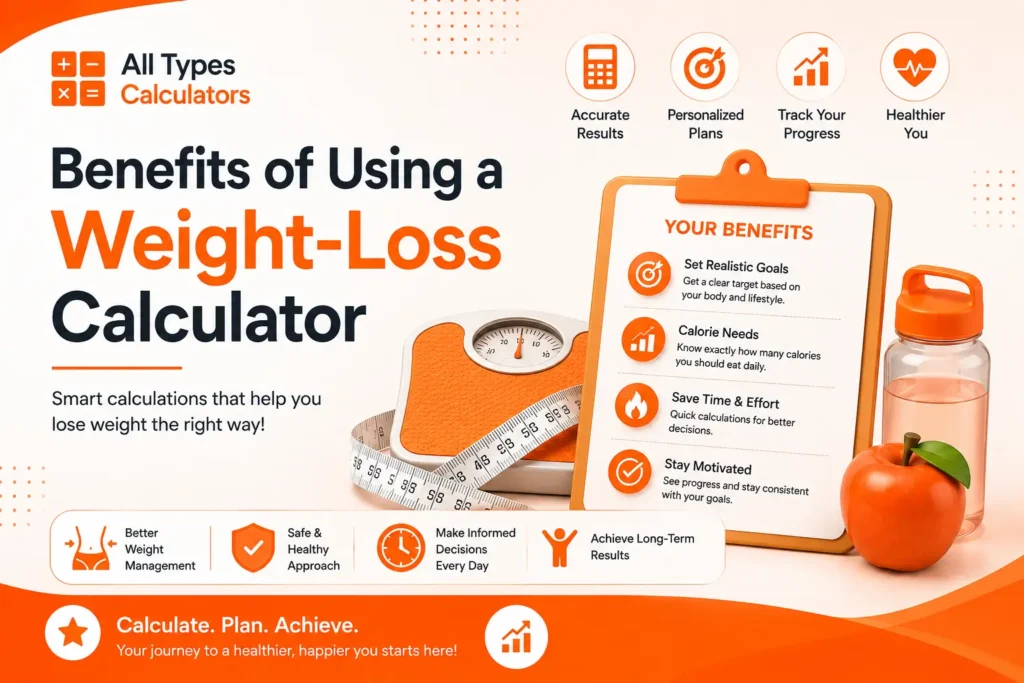
By using our online Losertown Calculator, you can get several benefits. Let’s discuss some of its key advantages.
Makes Goals More Concrete
The online weight-loss calculator makes your goals more concrete by turning a general desire into clear, measurable targets. It helps you understand where you are now and set realistic milestones that keep your progress on track. With personalized estimates, you can have a practical roadmap instead of relying on guesswork. Each calculated goal gives you a clearer sense of direction, making healthy changes feel more achievable. Use these insights as your starting point and take confident steps toward a healthier, more active you.
Shows the Effect of Calorie Changes
One of the key benefits of a weight-loss calculator is that it shows how changes in your daily calorie intake can influence your progress over time. It helps you see the potential impact of eating fewer calories or adjusting your activity level in a simple, visual way. By comparing different calorie targets, you can discover a balanced approach that fits your lifestyle. This makes it easier to understand your choices and stay focused on realistic results.
Encourages Realistic Expectations
Instead of chasing quick results, our free-to-use calculator encourages you to focus on achievable milestones that fit your lifestyle. By providing a clearer picture of your estimated progress, it helps reduce unrealistic goals and unnecessary frustration. This practical guidance keeps your journey focused, balanced, and motivating. Use each milestone as a step forward toward sustainable, long-term results.
Helps With Planning
Another benefit of a weight loss calculator is that it can help you estimate a suitable timeline, understand your daily calorie needs, and organize your approach more effectively. With a clearer roadmap, you can make smarter choices about nutrition, activity, and daily habits. This structure keeps your goals focused while making progress easier to track. Start with the numbers, build a realistic plan, and move forward with confidence.
Weight Loss Timeline Calculator: Track Your Journey to Your Goal Weight
A Weight Loss Timeline Calculator helps you see how long it may take to reach your goal weight with a clear and simple estimate. Just enter your current weight, target weight, and expected weight-loss rate to get a personalized timeline. It makes your progress easy to understand and helps you set realistic goals along the way. Instead of focusing only on the final number, you can track each step of your journey with confidence. Start planning your healthier journey today and see where your goals could take you.
Final Thoughts
To conclude the discussion, I would like to say that the Losertown Weight Loss Calculator offers a simple and practical way to understand how calorie intake may influence your weight-loss journey over time. While its results are estimates rather than guarantees, they can help you set realistic goals and better understand calorie deficits. Use the calculator as a helpful roadmap, while remembering that real progress can vary from person to person. With easy-to-understand tools and resources, All Types Calculators can help make everyday calculations simpler and more accessible. Start with realistic expectations, stay consistent with healthy habits, and let steady progress guide your journey.
Frequently Asked Questions
How can I calculate how much weight I have to lose?
To calculate how much weight you have to lose, simply subtract your target weight from your current weight, for example, if you weigh 80 kg and your goal is 65 kg, your estimated weight-loss goal is 15 kg. For a more meaningful target, consider your height, age, activity level, and overall health instead of focusing only on the number. Set a realistic goal, track your progress, and let steady, healthy changes lead the way.
How can I calculate what percentage of weight I lost?
To calculate the percentage of weight you lost, subtract your current weight from your starting weight, then divide the result by your starting weight and multiply by 100. For example, going from 80 kg to 70 kg means you lost 12.5% of your starting weight. This simple percentage gives you a clear, motivating picture of your progress over time.
How do I calculate fat loss?
To estimate fat loss, compare your starting body-fat percentage and current body-fat percentage along with your body weight. A simple method is to calculate fat mass at each point: body weight × body-fat percentage, then subtract your current fat mass from your starting fat mass. Keep in mind that home scales and body-fat measurements can be imperfect, so use the result as an estimate and focus on the overall trend.
How can I Calculate Daily Calorie Needs?
To calculate your daily calorie needs, first estimate your Basal Metabolic Rate (BMR) using your age, sex, height, and weight, then multiply it by your activity level to estimate your Total Daily Energy Expenditure (TDEE). For weight loss, you typically aim for a moderate calorie deficit from your estimated maintenance needs. Since individual calorie needs vary, treat the result as a helpful starting estimate and adjust based on your progress.